
Before Portrait Day: Planning Editorial Staff Headshots for HSSA in Tucson
People come to Tucson to learn animal welfare work. I've watched that happen since I started photographing at Pima Animal Care Center in 2013. Staff members build experience here, move into larger roles, speak at national conferences, and sometimes leave Tucson to lead programs and organizations elsewhere.
You can see the same career path inside the Humane Society of Southern Arizona. Five people in HSSA's current leadership previously worked at PACC: the CEO, chief veterinary officer, chief development and marketing officer, chief programs officer, and senior shelter manager. Some were already presenting nationally during their PACC years, while others are still building that part of their careers.
That context matters when you're planning staff headshots. When HSSA Art Director Eric Gonzalez reached out about a new series of editorial staff portraits, the photographs weren't being made only for an employee page. HSSA needs images for its website and donor communications, but the same people also appear at conferences, on podcasts, in media stories, in award announcements, on LinkedIn, and in places nobody in our planning meeting can predict yet. A portrait that works beside a staff biography may later introduce the same person to an audience that has never heard of them or HSSA.
The photographs have to survive that change of context.
Designing portraits for uses we can't predict
We spent little time in the planning meeting talking about camera equipment. We talked about where the photographs might end up, what each person's role communicates, and how much information I could put into a portrait before that information started limiting where HSSA could use it later.
A behavior specialist can make sense with training equipment because it tells you something useful about that person's work, and the context will probably remain relevant when the photograph moves from one use to another. An executive portrait has to travel farther. A prop that fits one story perfectly can make the photograph less useful for a conference biography eighteen months later, so the more broadly someone represents HSSA, the more room I want the photograph to leave for whatever comes next.
We also wanted the staff portraits to belong together without turning everyone into variations of the same person. During the planning meeting, someone described the goal as "professional, but still approachable." I translated that into a darker neutral background, directional light, compositions with room for future crops, and enough variation in pose and framing that each portrait could still respond to the person in front of me.
Building a studio in the training room
I bring the studio to commercial clients rather than asking a team to come to me, so for the test session I brought the same lighting, stands, modifiers, backgrounds, camera, and tethering equipment I'll use for the full staff session into HSSA's training room.
On this particular August afternoon, the distance between the car and the training room mattered more than usual. It was 107°F, the room was roughly 100 yards from where I could park, and moving a commercial portrait setup inside took several trips. HSSA also requires pants and closed-toe shoes for safety, so there wasn't much relief available from the Tucson heat. By the time the equipment was inside, I had a useful reminder that an on-location studio begins before the first light stand goes up.
Why the background isn't just gray
A neutral background made sense because HSSA can't know what every future publication, conference program, website revision, or media layout will look like. Keeping the color neutral gives future designers fewer problems to solve, while lighting and finishing let me decide how dark the background should feel for the portrait itself.
I didn't want a featureless corporate background. I used V-flats to create visible planes behind the subject and left the seams intentionally in the frame, a small reference to Irving Penn's corner portraits. Directional light and a darker tonal treatment gave those planes structure without tying the photographs to a color or graphic treatment HSSA may not want two years from now.
When Cody Half-Moon, HSSA's Senior Director of Marketing and Communications, came in for the test wearing black, which gave me a useful version of one of the questions we'd already discussed. I could let parts of the clothing disappear into the darker background while keeping enough shape through her face, hair, and shoulders to hold the portrait together. I also tested tighter framing, wider compositions, different body angles, and negative space that gives HSSA options when someone else eventually decides how a photograph needs to fit a page.
Cody tested the portrait
The first half of the session answered the questions a human subject could answer. I could see how dark I wanted the background, how much facial shaping I liked, how far I wanted to turn the body, how black clothing behaved against the set, and whether the treatment held together from a tighter portrait through a full-length composition.
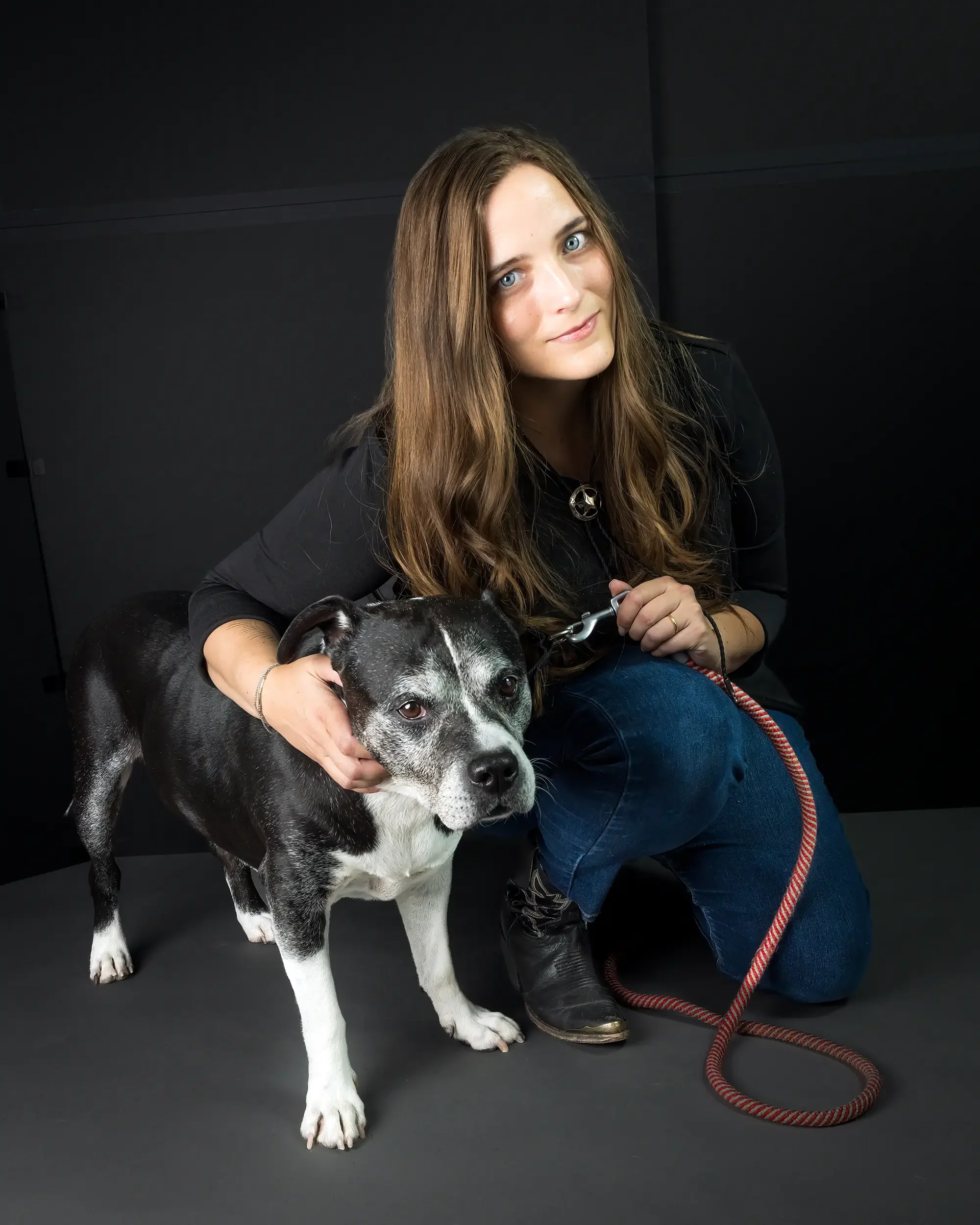
Cody’s test session prior to the full session.
The full-length frame also showed me that I'd put the set in the wrong place. I eventually climbed onto a table so I could fit Cody's head and feet into the same photograph, and I still had to use a wider lens than I wanted because I couldn't get enough camera-to-subject distance. Working that close with a wider lens changes the perspective of a full-length portrait, especially the relationship between whatever sits closest to the camera and the rest of the body. I could make it work, but I had no reason to build that compromise into an entire staff session when moving the set would fix it. On Thursday, the set moves farther back.
My tether also chose the test session to become temperamental. That was ten minutes of annoyance for a short session and exactly what I need to learn from a test. I'd rather discover a cable or connection problem while one patient stakeholder is helping me work through the setup than after the first person on a full staff schedule has stepped onto the set.
What went wrong with the tether:* Lightroom Classic 15.4 switched Canon tethering to a new Photo Transfer Protocol. In my case, Live View still worked, but photographs stopped transferring into the catalog. Adobe provides a fallback in Preferences: turn on Use Canon SDK for Tethering Canon Cameras and restart Lightroom Classic. Easy to research after the session, less useful while someone is standing on the set waiting for me to fix it.
By the time we finished Cody's individual portraits, I knew the lighting, background, framing, and general visual treatment would work. Then Sparky came in, and the questions changed.
Sparky tested the set
Adding an animal changes the geometry immediately. A small dog, a tall dog, and a person standing alone don't occupy anything close to the same composition, so before Sparky entered we brought over a dog cot and a blue chair and worked through where an animal might sit relative to the person. Both looked useful while we were planning around an empty set.
They mattered a lot less once we had a dog. We tried the furniture, moved Sparky, moved things around him, used treats, and experimented with ways to get his attention. I tried sound.
The squeaker did nothing.
What worked better was letting Cody come down to Sparky's level and interact with him instead of trying to fit him into the composition we'd planned. Once she responded to the dog in front of her, Sparky looked at Cody and Cody responded to Sparky. The photograph became about the interaction that was actually happening, and the cot and chair stopped solving anything I needed solved.
Working with Sparky also exposed problems a human-only test couldn't. I liked the visual structure the V-flats created behind Cody, and I'd also considered using additional panels to narrow a dog's visual field in HSSA's large, echoey training room. Once Cody, Sparky, his handler, the lights, furniture, and I all occupied the same area, those side panels made it harder for people to move around the dog. I opened the working area while keeping the background planes that create the visual treatment I wanted. On August 20, I'll add side panels only when the animal in front of me benefits from them.
Sparky also changed how we'll move people through the room. Someone waiting across the room may barely register to me while I'm looking through the camera, but to a dog that person can become the most interesting thing in the building. We'll keep waiting staff outside the current animal's direct sightline as much as possible while still giving me enough camera distance to make the full-length portraits at the perspective I want.
Sparky had his own schedule
Eventually he started looking toward the exit. In the later frames, the martingale collar had gone from loose to visibly tensioned as Sparky moved forward and his attention shifted away from Cody and the set. We tried another moment or two.
He was done.
I've photographed animals long enough to know that another five minutes on my schedule doesn't create another five useful minutes for the dog. A staff calendar may give me thirty minutes, but the animal standing in front of me has his own clock. The full session needs enough flexibility for both of them to coexist.
What the test changed
For August 20, the two biggest physical changes are simple. I'll move the entire set farther from the wall so I can work at the camera distance I want, and I'll keep the Penn-influenced background planes while treating the additional V-flats as optional tools for individual animals rather than permanent walls around the set.
I'll also wait to make the final finishing decisions on Cody's portraits until I've photographed the rest of the staff. I can make a rough edit now, but background density, contrast, and the small tonal choices that make a portrait series feel coherent are easier to judge when I can see the whole group rather than one person in isolation.
On Thursday, the rest of the HSSA staff got their vote.
