The Patience Transfer

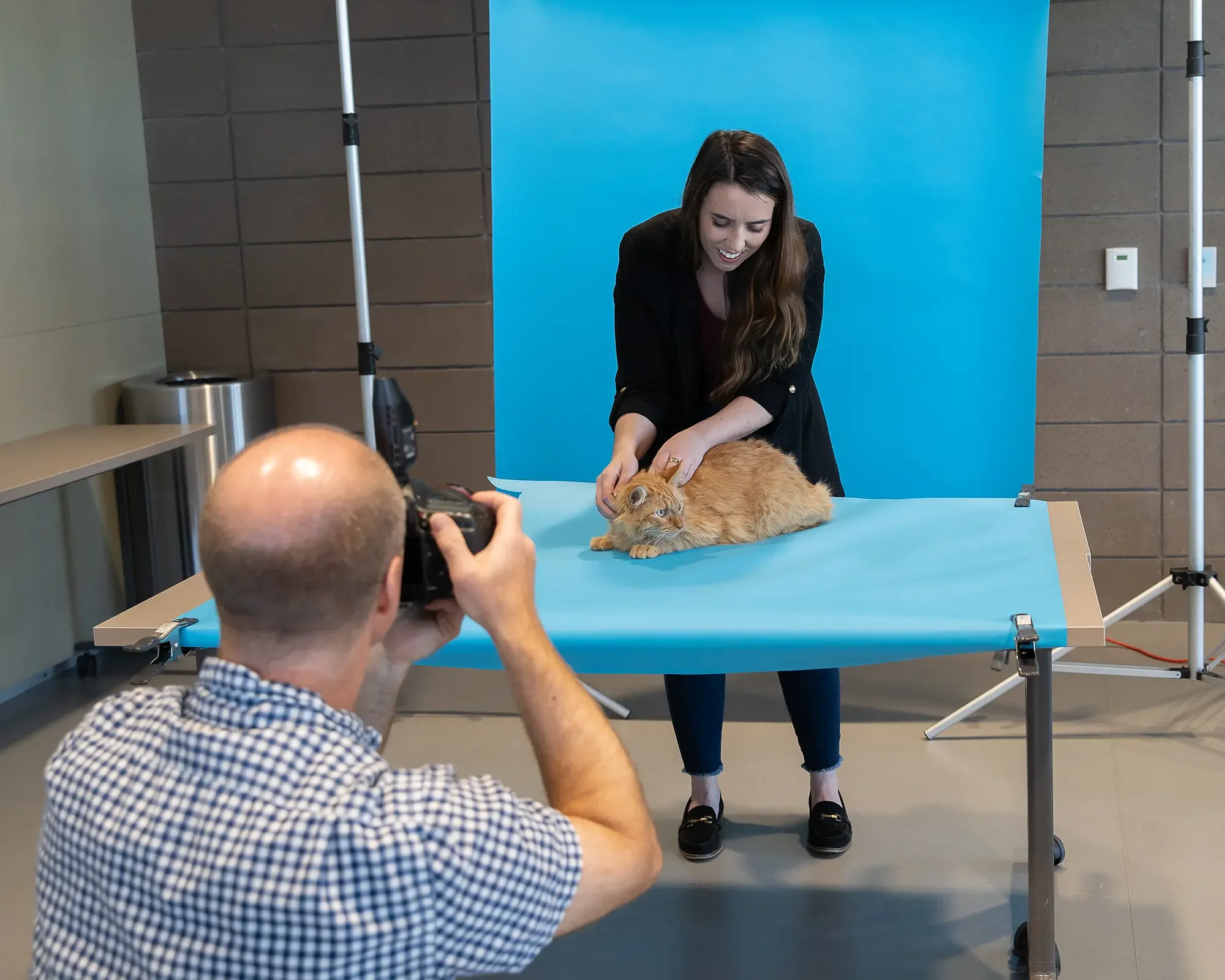
Board of Directors portrait session for Friends of PACC: creating a calm, low‑stress setup so both Mikaela and her cat are comfortable in front of the camera. (photo courtesy of Reena Giola)

I'm a patient person. Not performing patience, not reminding myself to slow down. Just wired that way, which I recognize is not universal and shouldn't be taken for granted. I don't rush shelter animals in sessions because I'm impatient to get to the next thing. I don't really operate on to-do lists in any meaningful way on a session day, which probably says something about me, and is, I'm told, an ongoing frustration for my wife. If an animal needs time, we take time. I'll push a comfort zone occasionally, because a photography session is well outside what any dog or cat could reasonably call normal, but pushing a comfort zone and rushing are different things.

What the shelter taught me, though, is that being patient and appearing patient to an animal are not the same thing. It turns out the same distinction shows up in executive portrait sessions just as clearly as it does in a kennel.

You can be waiting in a way that transmits urgency. The posture is right, the pace is right, but something underneath is impatient, and animals receive that signal with a directness that humans are too polite to acknowledge. The dog doesn't ignore it. The dog goes further into the corner.

I've been photographing shelter animals since 2005, starting at Woodford Humane Society in Kentucky, then Benton-Franklin Humane Society in Washington state, and for the past several years at Pima Animal Care Center and the Humane Society of Southern Arizona here in Tucson. Twenty years across three states. That’s not a credential the way MFA is a credential or CPP is a credential, but it is the backbone of how I photograph both adoptable animals and executives who would rather be anywhere else. It's closer to what happens to your eyes when you spend enough mornings with animals who have no stake in cooperating with you. They can't be coached before the session. They can't be reasoned with. "We're just going to do a few quick shots for the website" is not a phrase that lands with a dog who arrived three days ago and has spent most of those days unsure about the nature and intentions of every person who walks through the kennel door.
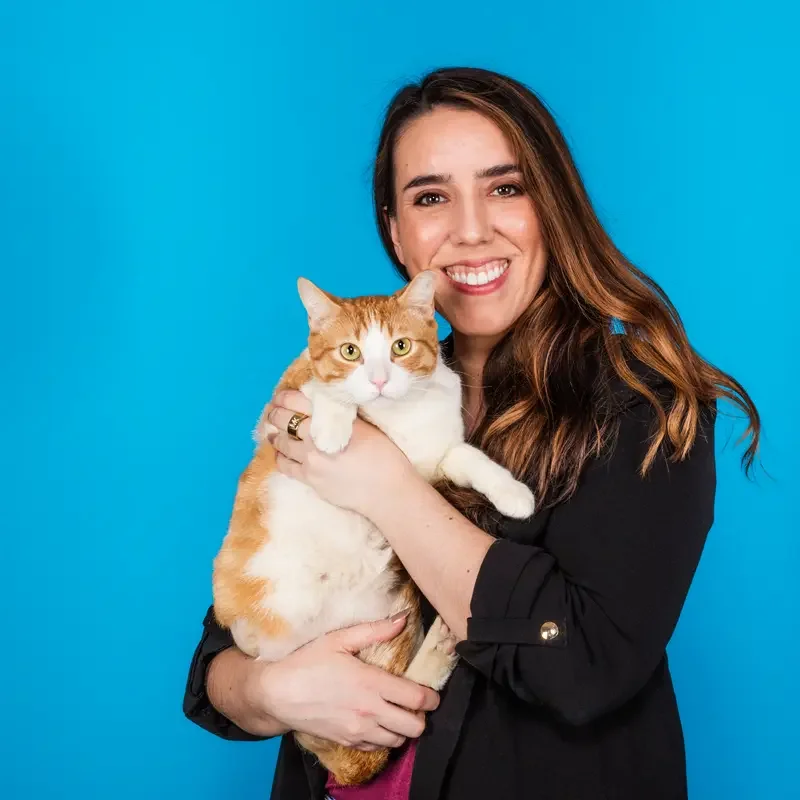
The final portrait.

What you learn, over enough of those mornings, is that comfort isn't something you can explain into existence. You build it through behavior, through specific behavior, over specific time. The animal watches what you do, not what you intend. The shutter sound either becomes routine or it doesn't, based on how many times you've fired it with nothing bad following, not based on whether you told them it was going to be okay.

This is one of the places where mirrorless cameras changed something real. An electronic shutter fires without any mechanical sound. The first time you photograph a cat in silent mode and the cat doesn't move, because from the cat's perspective nothing happened, you understand immediately why that matters.

At some point, I started noticing something in executive portrait sessions that I had only previously encountered in shelter work.

The senior partner who sits down in front of the camera with the expression of someone waiting for a moderately unpleasant medical procedure. The real estate agent who has been photographed for fifteen years and has learned, over those fifteen years, to produce a version of her face that reads as friendly without actually being present. The physician who is technically sitting still and technically looking at the camera and is, in every frame, obviously somewhere else.

You might be able to fool some people with that. After enough hours studying faces on a screen, you don't fool me. And in an era when everyone has been photographed more, through video calls and social media and LinkedIn profiles and every other surface that requires a face, the performance has gotten more practiced. More practiced performance is still performance, and a portrait needs a person, not a performance.

I don't know exactly when I made the connection between the two. It wasn't a revelation so much as a gradual recognition, the kind that arrives on the drive home after a session when you realize you've been solving the same problem in a different species. The nervous executive is not nervous in the way a frightened dog is nervous. But the underlying fact is similar: they've learned to produce a performance of being photographed rather than to actually be photographed.

The tools for addressing it are essentially the same.

Work slowly, not to seem patient but because working slowly is patience. Move the camera before it's technically ready, because waiting for perfect stillness transmits your own tension back. Let silence do work. Don't fill every quiet moment with direction. Ask questions that require actual thought, not the performance of thoughtfulness. Watch for the moment when the person in front of you forgets, briefly, that a camera is present.

That moment exists in most sessions. It doesn't always arrive. It arrives more often when you've built the conditions for it than when you've tried to manufacture it by asking someone to relax, which is an instruction no one in the history of photography has ever successfully followed.

People occasionally ask whether I use treats in executive portrait sessions.

No, but the squeaker works great.

To someone who doesn't know the shelter work, that reads as a photographer being glib. To someone who does, it describes something real: the skills built over twenty years photographing shelter animals and pet portrait clients who couldn’t be coached translate more directly than I expected to photographing professionals who are performing being comfortable rather than actually being comfortable. Two different clients, two different sessions, the same problem underneath.

The squeaker is a joke about a real thing. That's usually where the useful insights live.

Next
Next

You Just Graduated. Here's the One Thing Missing From Your LinkedIn.