
The Grove, Shadwell Farm
Tree museum
There's a moment in the series post where I mention that the infrared process made the ordinary strange enough to actually look at. This image is the clearest example I have of what I meant by that.
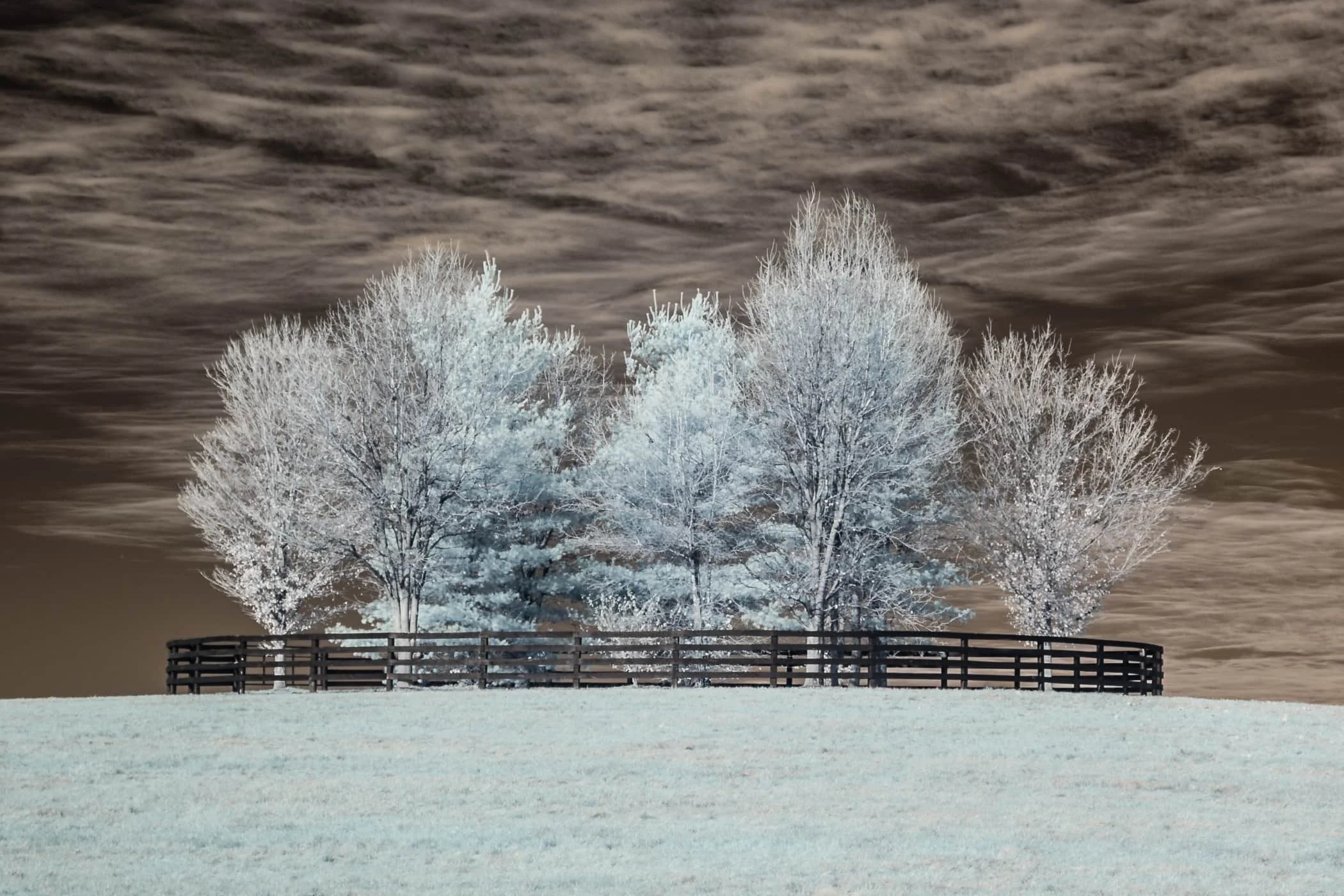
On its face, it's a simple composition. A cluster of trees enclosed by a black board fence, sitting on the crest of a rise in the middle of a horse farm pasture. Nothing dramatic is happening. There's no weather event, no animal, no human presence. Just trees in a fence on a hill, with a sky gone heavy and wave-like the way infrared skies often do.
And yet it stopped me.
I've thought about why for a long time. Some of it is the composition itself, the way the fence describes such a careful, deliberate arc around the base of those trees. Board fences in central Kentucky are everywhere, and they're almost always in service of something practical: keeping horses in or out, marking property lines, managing pasture rotation. This fence isn't doing any of that. These trees don't need containing. There's nothing here that requires a fence except a decision someone made, at some point, that these trees were worth marking off from the rest of the world.
That's what the image keeps asking me: why the fence?
I didn't have the language for it when I made the photograph in December 2007. It wasn't until years later, after we'd moved to Washington and eventually to Tucson, that a line from an old Joni Mitchell song surfaced and stuck. The one about taking all the trees and putting them in a tree museum. I'm not saying the image is about that, exactly. But the tension it names, between care and display, between preservation and enclosure, is the same tension I feel every time I look at this frame.
The infrared rendering doesn't soften that tension. If anything, it sharpens it. The foliage goes luminous and pale, the fence goes dark and precise, and the whole scene takes on the quality of something deliberately preserved. Like a specimen. Like a memory.
This print is part of the Unseen: Kentucky series, available as an open edition in smaller sizes and a limited edition of 25 at 11x14. If you want to read more about where the series came from and why it still matters to me, that's in the series post.
