
The Light That Was Already Leaving
There's a particular kind of attention you pay to a place once you know you're leaving it.
I know that now more than I did in 2007, when my wife and I were beginning to understand that Lexington wasn't going to be home forever. She had career opportunities pulling us elsewhere, and the honest truth is that I didn't fully absorb what that meant until I started pointing a camera at things I'd been walking past for years without really seeing.
That's what the Unseen: Kentucky series is about, at its core. Not Kentucky as a travel destination or a scenic backdrop, but Kentucky as the particular place I was in the process of walking away from.
The camera I used was modified to record infrared light, wavelengths beyond what human vision can detect. I had it built specifically for this work. Infrared photography does something uncanny to the landscape: green foliage goes white and luminous, shadows deepen past what daylight normally allows, skies turn heavy and dramatic. Everything familiar becomes strange and slightly otherworldly. At the time, I thought I was making a documentary series. What I was actually doing, I think, was finding a visual language for memory before the memories had fully formed.
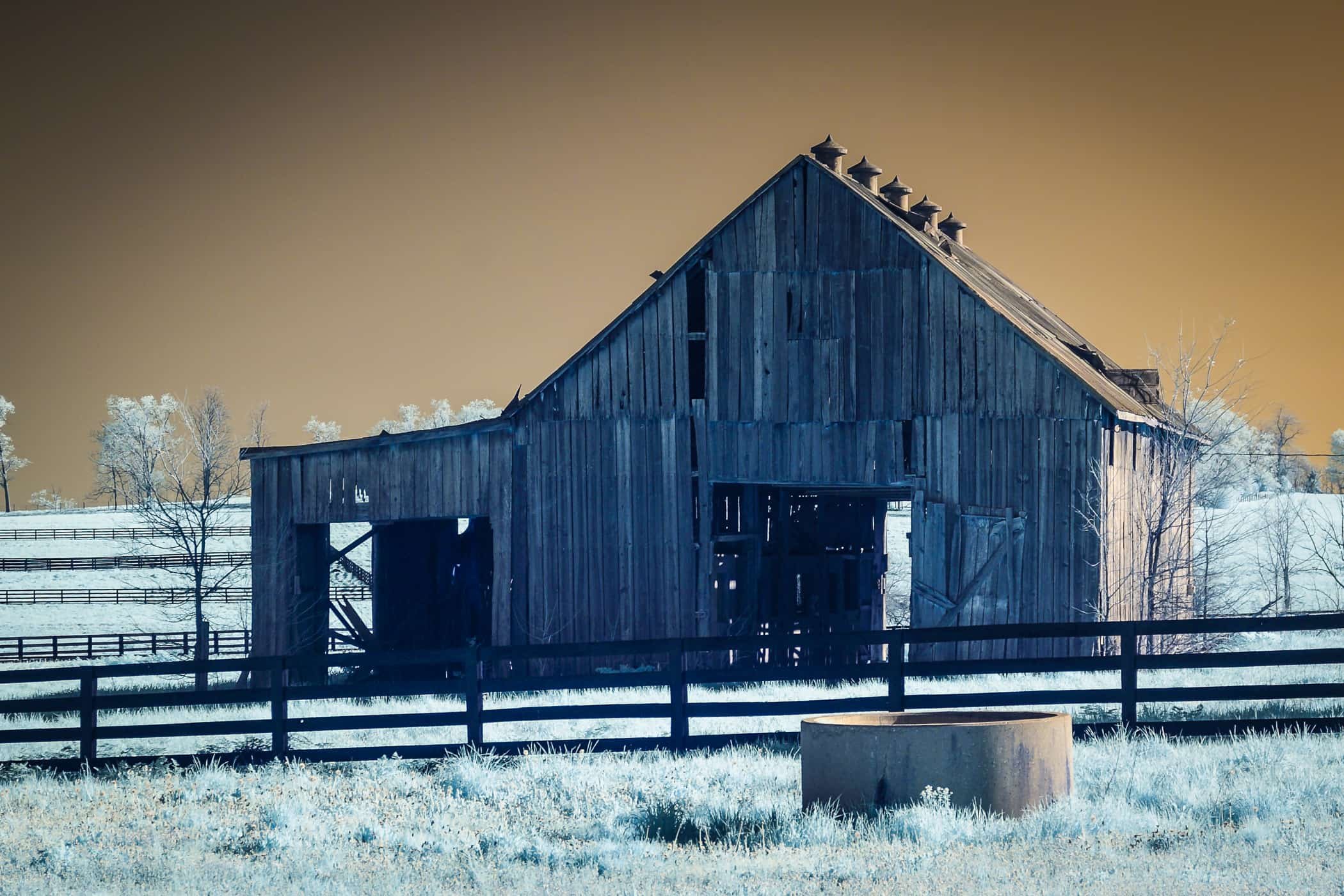
This infrared study documents a weathered tobacco barn with its distinctive ventilation architecture—the adjustable slot panels along the roofline that generations of farmers manipulated to control airflow during leaf curing. Infrared capture transforms agricultural pragmatism into luminous meditation, the white-glowing foliage contrasting against the barn's geometric austerity and the warm amber sky characteristic of near-infrared wavelengths at dusk.
The image speaks to Kentucky's layered agricultural identity beyond its celebrated horse farms. This is working landscape, vernacular architecture shaped by crop requirements and seasonal necessity rather than aesthetic aspiration. Yet infrared revelation elevates utilitarian structure to fine art subject—the functional ventilation slots become compositional elements, the weathered wood gains textural gravitas, the surrounding vegetation glows with electromagnetic energy invisible to conventional perception.
5x7 (Open Edition): $95
8x10 (Open Edition): $135
11x14 (Limited Edition of 25): $285
Location: Rural tobacco farm, Kentucky Bluegrass region
Part of the Kentucky Infrared Series (2006-2008), created during the artist's Bluegrass period. This body of work earned exhibition placement in the Chancellor's Art Exhibition Series at Washington State University Tri-Cities, exploring Kentucky's iconic landscapes through the transformative lens of infrared photography.
Editions & Materials:
Open Edition (5x7, 8x10): Archival giclée on premium lustre paper
Limited Edition (11x14, edition of 25): Museum-quality Hahnemühle Photo Rag, numbered and signed
About the Artist: Michael Kloth, MFA, CPP. Work held in TMC Foundation permanent collection. Member, Professional Photographers of America and American Society of Media Photographers.
The horse country around Lexington is its own kind of place. The three-plank fences, the tobacco barns weathered past any attempt at restoration, the Keeneland backstretch on a quiet morning before the crowds arrive, the pastures that roll in long slow waves toward the tree lines. I'd lived with all of it for years, close enough that I'd stopped noticing the particulars. The infrared process gave it back to me. It made the ordinary strange enough to actually look at.
I spent a lot of 2007 and 2008 working through those landscapes. Keeneland was a recurring subject, not because it's iconic (though it is), but because it captured something about the relationship between ritual and place that felt important. The racing season, the placing bets, the interlude between races where everyone mills around looking both purposeful and unhurried. I made images there that feel, to me, less like documentation and more like atmosphere preserved in silver.
The tobacco barns were harder to articulate at the time. They're monuments to an agricultural history that was already fading when I was photographing them, structures so deeply embedded in the central Kentucky landscape that they'd become almost invisible through familiarity. The infrared process made them monuments again, rendered them as massive and deliberate against the white sky.
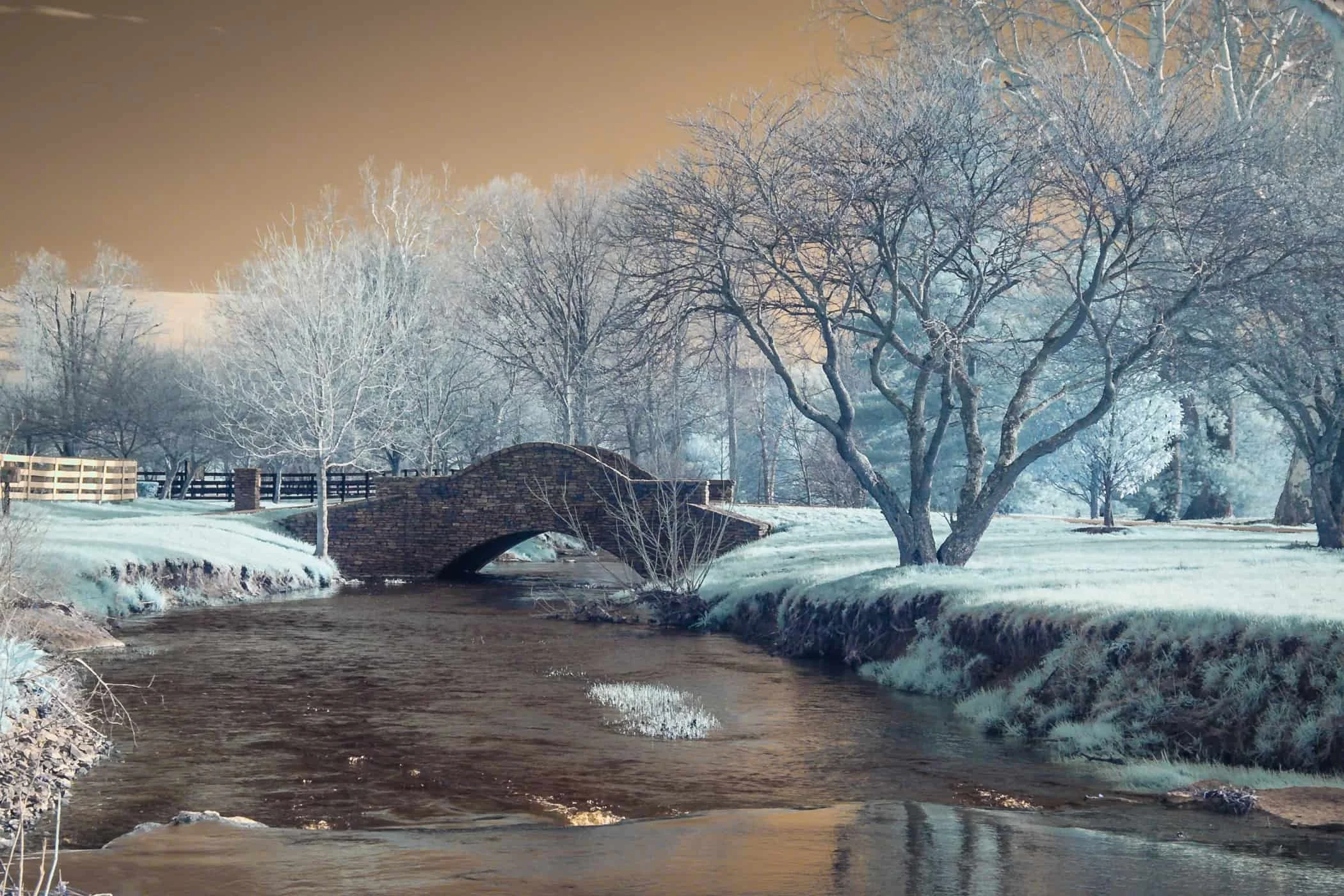
A weathered stone bridge spans Frog Creek in this haunting infrared composition, where the Bluegrass landscape transforms into a realm of otherworldly beauty. The trees flanking the water's edge become luminous sentinels, their foliage rendered in brilliant whites by the infrared spectrum, contrasting dramatically with the sepia-toned sky and the dark ribbon of water below.
The infrared spectrum captures what the human eye cannot perceive, revealing the hidden energy of the natural world. The creek's surface reflects this duality, mirroring both the terrestrial and the ethereal in its journey beneath the historic crossing.
Images from this Kentucky infrared series earned exhibition placement in the Chancellor's Art Exhibition Series at Washington State University Tri-Cities, and this particular composition may have been among those selected for its atmospheric depth and technical mastery.
Sizes & Pricing:
5x7 (Open Edition): $95
8x10 (Open Edition): $135
11x14 (Limited Edition of 25): $285
Location: Frog Creek, Lexington, Kentucky
About This Series
Part of the Kentucky Infrared Series (2006-2008), created during the artist's Bluegrass period. This body of work earned exhibition placement in the Chancellor's Art Exhibition Series at Washington State University Tri-Cities, exploring Kentucky's iconic landscapes through the transformative lens of infrared photography.
Editions & Materials:
Open Edition (5x7, 8x10): Archival giclée on premium lustre paper
Limited Edition (11x14, edition of 25): Museum-quality Hahnemühle Photo Rag, numbered and signed
About the Artist: Michael Kloth, MFA, CPP. Work held in TMC Foundation permanent collection. Member, Professional Photographers of America and American Society of Media Photographers.
There's an image in the series called Frog Creek Passage that still stops me when I look at it. It's quieter than the Keeneland work, more understated, a creek moving through tree cover with that characteristic infrared glow on the leaves. It looks like a place that exists slightly outside of time. Which, I suppose, is exactly what memory does to places we've left.
We moved from Lexington to Washington state in 2008, and I eventually landed in Tucson in 2011. The Unseen: Kentucky series came with me, though it took years to fully understand what I'd made. That's often how it goes with personal work. You make something in the thick of living it, and the meaning clarifies later, at a distance, when you can see the shape of the whole thing.
The infrared process, I've come to believe, is inherently a nostalgic one. It doesn't show you what your eyes would have seen. It shows you something adjacent to that, something filtered and transformed by light you couldn't directly perceive. That seems right, for work made in a place I was already, quietly, beginning to carry with me.
The series is part of my permanent fine art collection, available as archival giclée prints in the Unseen: Kentucky. If central Kentucky's landscapes have any resonance for you, whether you're from there or just drawn to that particular geography, I'd be glad for these images to find their way onto your walls.
